
Moose is a platform for software analysis. To analyze a program, Moose needs a model. We have two kinds of models: Famix models that represent the entities and dependencies of a software system, and FAST models that represent the AST of a program.
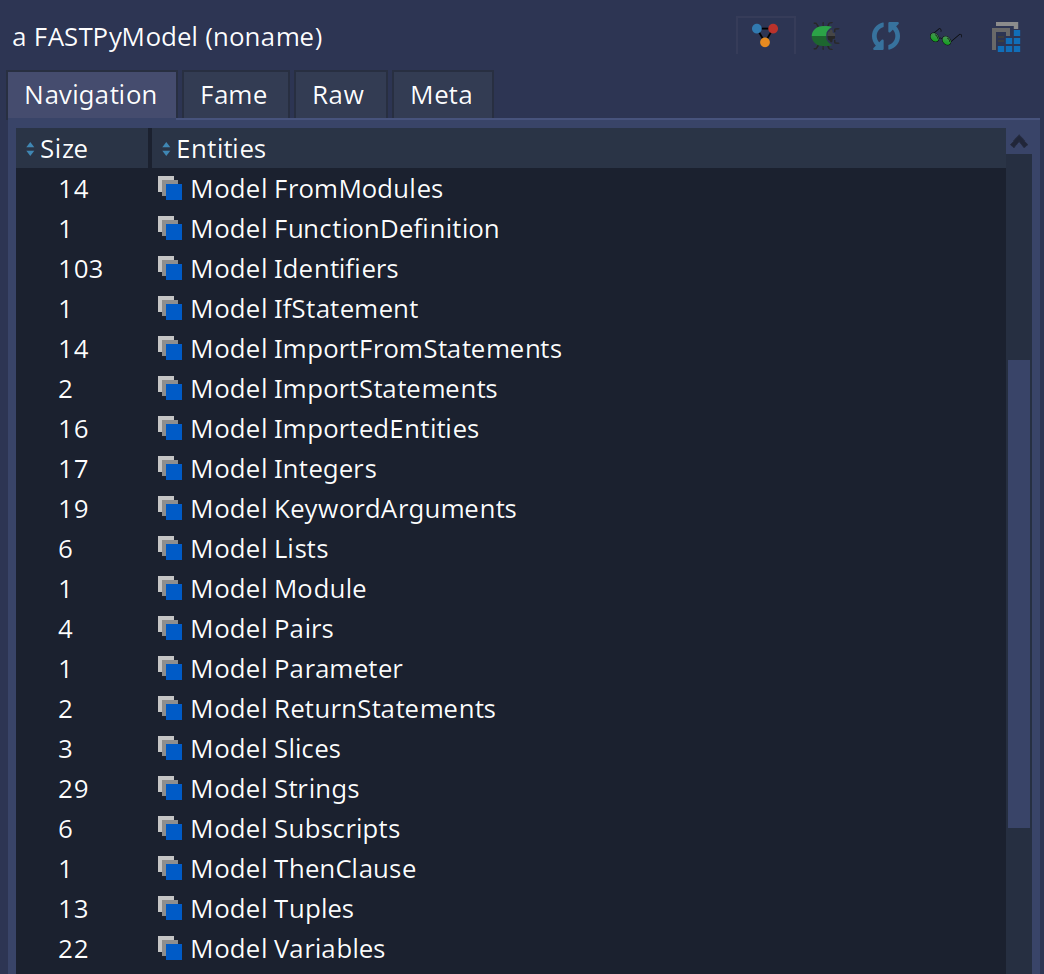
Over the past months I have been working on FAST-Python: a complete toolkit to import, resolve, and analyze Python code in Moose. The project currently has more than 1300 tests to make sure everything works as expected.
The Python Importer
Everything starts with importing Python source code into a FAST model. The importer parses Python files and produces a FASTPyModel containing the full AST. It supports importing entire projects or single snippets:
model := FASTPythonImporter parseFileAndResolve: aFileReference.
The parseAndResolve: variant also runs the local resolver and SSA on the imported code, which is what most analyses need.
The Local Resolver
Raw AST nodes do not know what they refer to. Is x in print(x) the same x as the one assigned three lines above? The local resolver answers that question.
FASTPythonLocalResolverVisitor walks the AST and links each named entity to its first declaration. Once resolved, you can ask any node for its #localDeclaration to find where it was declared, and #localUses to find every place that refers to the same declaration.
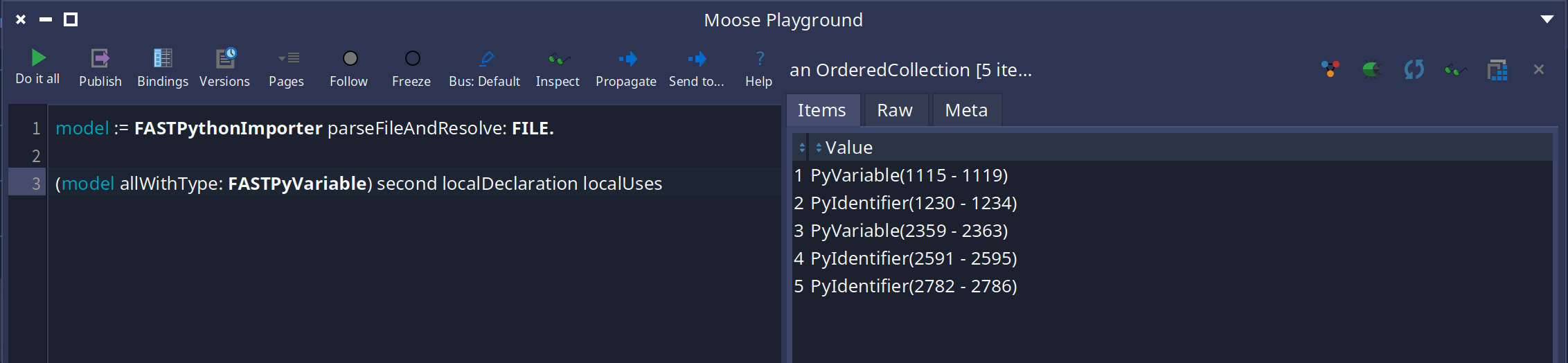
Python makes this tricky because anything named can shadow anything named — a variable can be shadowed by an import, which can be shadowed by a function, all in the same file. The resolver tracks these chains via #shadowedBy and #shadowing links, keeping each declaration’s uses independent.
The SSA Resolver
The local resolver tells you what a name refers to, but not which assignment is responsible for a particular use. That is what the SSA (Static Single Assignment) provides.
FASTPythonSSAVisitor builds a SSA form of the AST. After resolution, every variable use knows exactly which assignment(s) can impact its value. When a variable can receive values from multiple assignments (for example, inside different branches of an if), the SSA creates a Phi version that groups all possibilities.
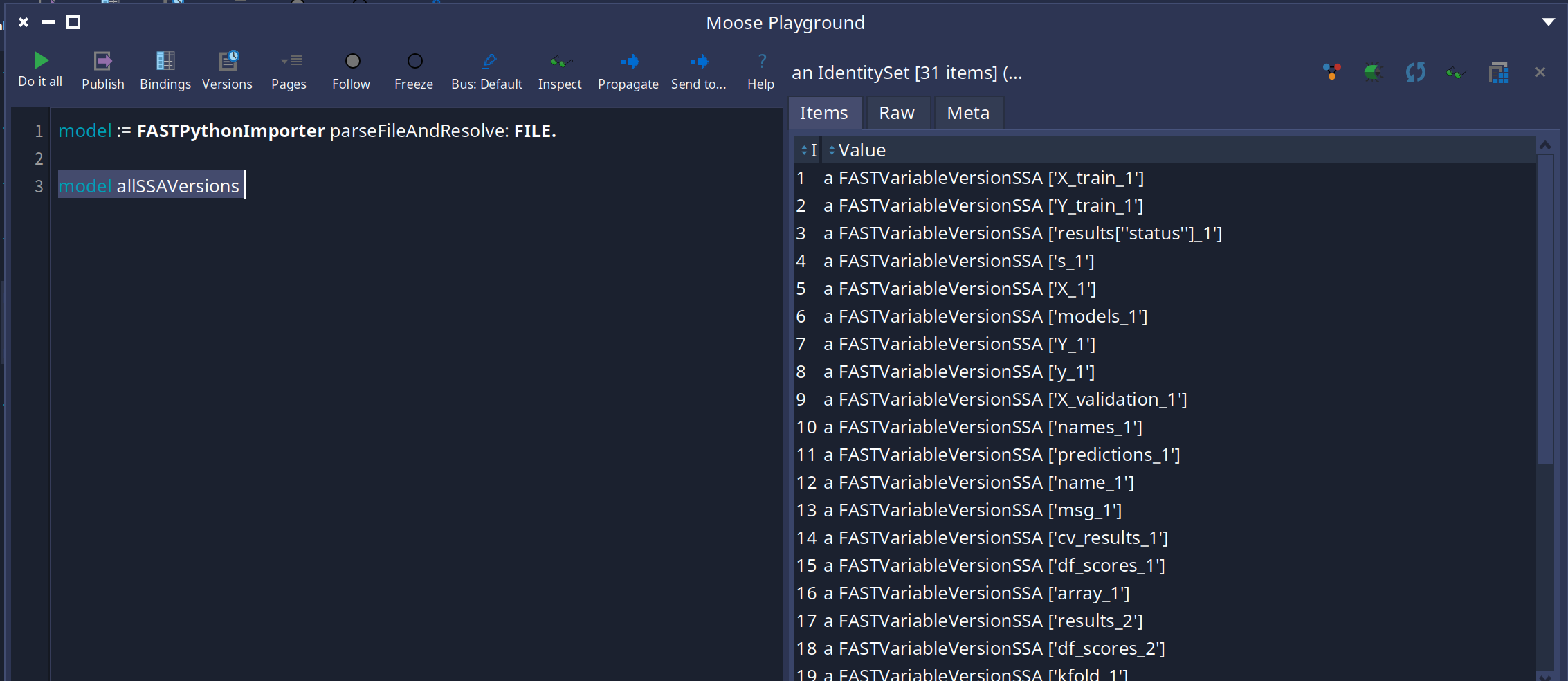
"Where does this use of x come from?"
lastPrint := model module statements last arguments first.
lastPrint ssaVersion.        "Phi(x_2, x_3) — two possible assignments"
lastPrint versionWriteAccesses. "the two writes that can reach this use"
This enables powerful queries: what expressions are assigned to a variable? What is the transitive assignment chain? Which reads are reachable from which writes?
The Control Flow Graph
FAST-Python also builds a Control Flow Graph for behavioral entities (modules, functions, methods, lambdas, classes). The CFG represents all possible execution paths through the code.
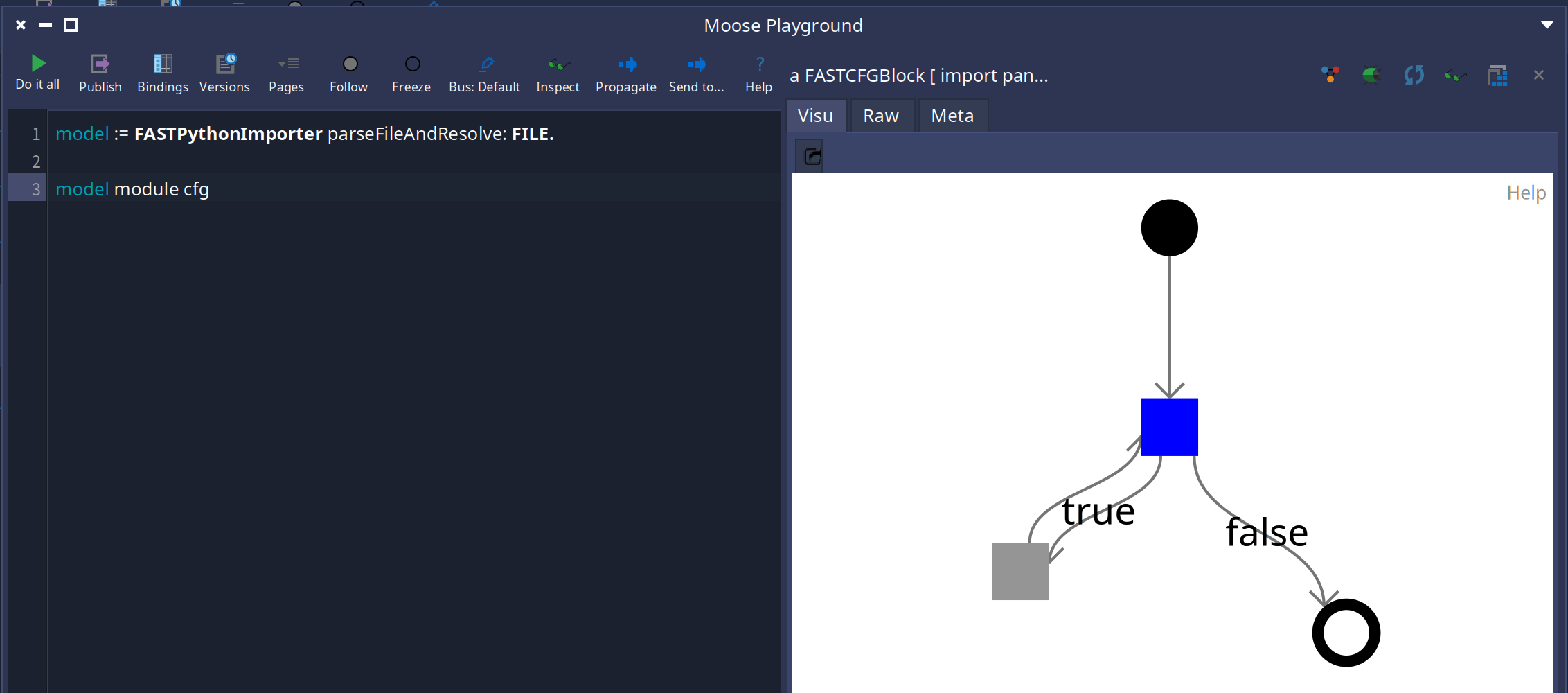
FASTPythonCFGVisitor buildCFGOf: aFunctionDefinition.
The CFG is built using a dedicated visitor that walks expressions and next blocks, visiting each conditional branch independently. It is used internally by the SSA resolver and is also available for custom analyses.
The Analysis API
On top of all of this, FAST-Python provides an API to answer real analysis questions about Python software. Here are a few examples:
Where is a variable written?
lastPrint ssaVersion versionWriteAccesses.
"the writes that can impact this specific use"
Where is a variable read?
lastPrint versionReadAccesses.
"every read reachable from this SSA version"
What expressions are used to assign a variable?
lastPrint assignedExpressionsMap.
"a Dictionary(mapping each write access to its assigned expressions)"
What are the transitive assignments?
lastPrint transitiveAssignedExpressionsMap.
"follows variables in assigned expressions recursively"
Which calls are made on a variable?
variable callsOnVariable.
"only calls where the variable is the receiver, e.g. x.append(1) or x()"
Each of these queries works at different granularity levels — you can ask about all accesses of a variable, or only the ones reachable from a specific SSA version.
Limitations
The current implementation has known limitations:
- Attribute accesses like
x.y.z = 3followed bya = x.y; print(a.z)are not fully resolved — the link through the intermediate variable is missing. - Subscript comparisons use string matching, which means
x[0:4]andx[:4]are not recognized as equivalent. - Instance variables cannot be tracked by the SSA since Python has no explicit declarations and method call order is unknown.
- Python 2 scoping rules (e.g. list comprehension variable leaking) are not supported — the resolver targets Python 3 behavior.
Conclusion
FAST-Python is actively being used to answer real analysis questions on Python codebases. The combination of local resolution, SSA, and the CFG gives us a solid foundation for data-centric analysis.
The full documentation is available in the FAST-Python repository.
I had a very attentive supervisor reviewing every commit on this project.
